21 May Types of Death Notices Announcements Indian Newspapers Guide
Table of Contents
- Introduction
- Category 1: The Obituary — Immediate Announcement of a Passing
- The Language of Immediate Announcement
- What an Obituary Advertisement or Death Notice Must Include
- Category 2: Ceremonial and Ritual Notices
- Chautha and Terahvin (Hindu Tradition — North India)
- Besna (Gujarati and Marwari Communities)
- Uthala (North India — Punjabi and Hindu Communities)
- Bhog and Antim Ardas (Sikh Community)
- Funeral Mass and Month's Mind (Christian Communities)
- Prayer Meeting (Cross-Community, Secular)
- Category 3: Condolence Notices
- Category 4: Remembrance Ads — Honoring an Anniversary
- Practical Tips for Booking the Right Ad
- Frequently Asked Questions
Understanding Indian Death Announcements and Obituary Advertisements
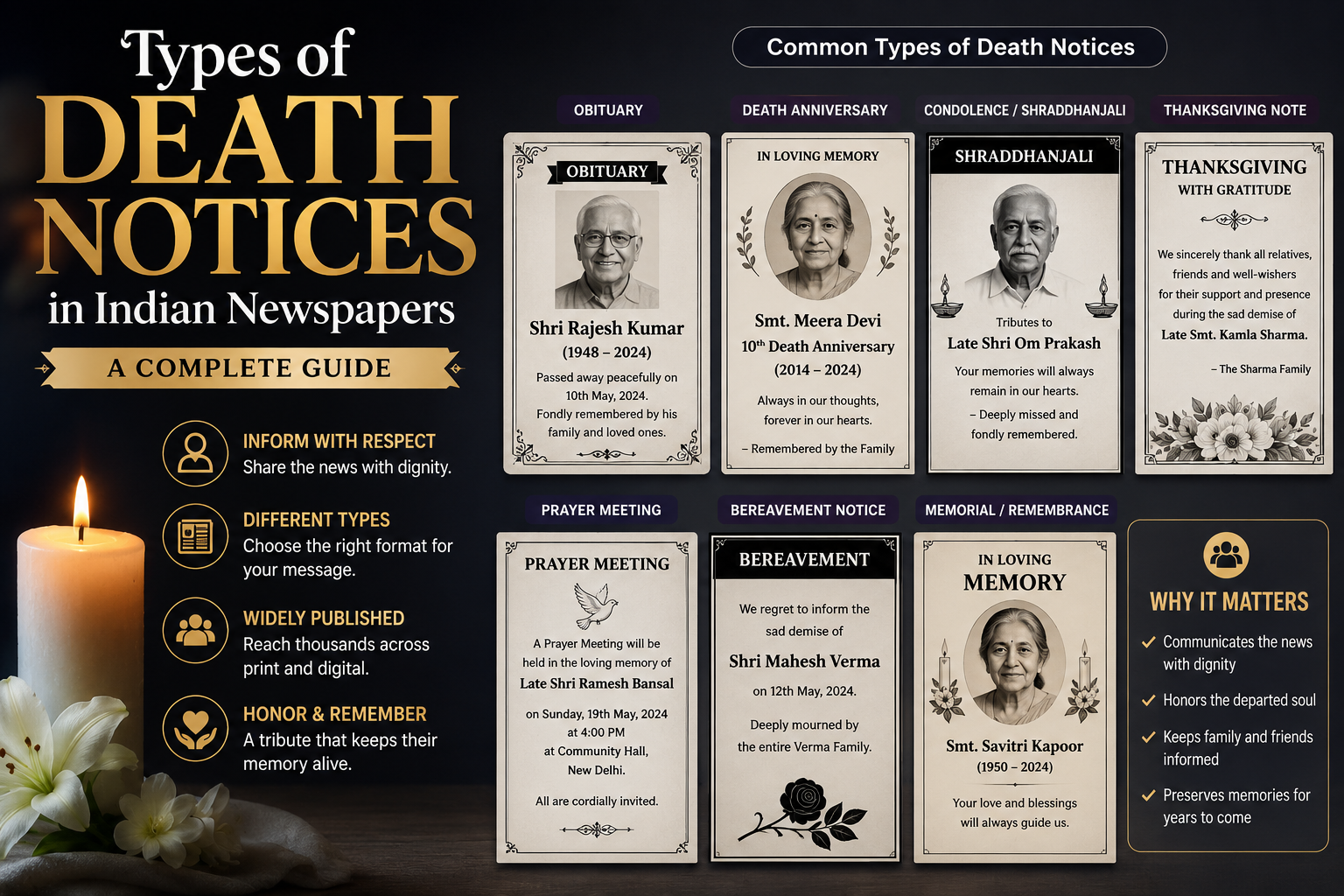
Obituaries provide information regarding someone's death and provide information about the family or funeral. Remembrances are used to give families heartfelt memories to celebrate anniversaries or other special days. Through Ceremonial Notices, relatives and friends are asked to attend prayer meetings, memorials or religious service in memory of the deceased.
The concept of public grief is still deeply rooted in Indian culture. Families may use a newspaper death notice to help communicate the news of the death to family, neighbours and the community. The morning paper has a more professional feel and tone to it, and it's more respected than social media messages are, so that's why many people trust it more. A printed notice also allows people to gather and pray for, to support, and to remember the person who has passed away.
There are lots of obituary ads in Indian newspapers and each one has a unique function throughout a family's suffering. Each of the following notices – A Sad Demise notice, death ad, Chautha invitation, Besna gathering notice, and Shradhanjali ad – has its own unique tradition, time and customs, depending on religion, region and family practices. When families use an appropriate newspaper notice, they are able to convey important information clearly and respectfully to relatives, friends and the community. This guide will help you understand the meaning and function of all the major types of obituary ads, so you can select the right one now, and with confidence, even in the midst of an emotional and difficult time.
The Ultimate Guide to Newspaper Advertising for Funerals and Remembrances in India
Category 1: The Obituary — Immediate Announcement of a Passing
The first newspaper notice is typically the one that comes out 24–48 hours after the death of a family member. This is an announcement that they make to the family, friends, neighbours and community to let them know what has happened. The notice also provides a range of important information regarding the funeral, prayer service or last rites, which allows people to attend, provide support and pay their final respects.
The Language of Immediate Announcement
The Indian style of writing death notices is very respectful and it is immediately identified by people in the newspaper death notice section. These notices are usually begun with familiar and heartfelt words which clearly explain the purpose of the notice. The words at the start of the notice give the reader a sense of what the notice is conveying: news of a passing, invite to a prayer meeting, or honour to a loved one. Common openers include:
- "With profound grief..." — the most common, formal, and cross-community phrase.
- "It is with deep sorrow that we announce the sad demise of..." — formal, used for professional and civic figures.
- "Left for heavenly abode" — widely used in Hindu and Sikh communities, implying a peaceful spiritual transition.
- "Called to eternal rest" — common in Christian communities.
- "Went to be with the Lord" — used in Protestant Christian families.
- "Returned to Allah's mercy" — used in Muslim families following Islamic tradition.
The death notice is meaningful in such a way that the first line of it resonates with the family and the readers. Words people use can often reveal their beliefs, the nature of their losses and feelings. In most instances, readers comprehend the emotion and intent of the notice on the first line.
What an Obituary Advertisement or Death Notice Must Include
- Full legal name — Include the name by which the person was known publicly in the newspaper announcement, not just formally. If they were called "Babaji" by the entire community but registered as Rameshwar Prasad, consider including both in the obituary notice.
- Dates — Date of birth, date of passing, and sometimes the age at the time of death. In communities where astrological and lunar calendar dates matter, some families include the tithi alongside the Gregorian date in the remembrance ad.
- Family details — Listed in the "In Grief" or Kripakanshi format (a traditional way of listing surviving family members by relationship in a newspaper obituary). Spouses come first, then children by name, then grandchildren, and sometimes the extended family or family business name.
- Photograph — Not mandatory, but strongly recommended in Indian death notices. Given the frequency of shared names across India's large population, a photograph helps community members recognize the person in the classified advertisement. For display obituary ads, a clean portrait photograph at 300 DPI or higher is required.
- Ceremony details — The time, date, and full address of the funeral announcement, cremation, or burial. Ensure these details are clear in the newspaper death notice to avoid confusion for attendees.
Category 2: Ceremonial and Ritual Notices
Indian mourning is not just during the funeral. Families still carry on with a series of ceremonies and prayer meetings in the days thereafter in many Indian communities. Cultural significance and emotional value is unique for each ceremony. Families will often print separate newspaper notices for each ceremony, to let relatives, friends, neighbours and well-wishers know. These notices will contain all the information about the date, time and location for people to come and pray, and support the family during their time of grieving.
The widest range of regional and religious traditions are included in this category of death notice in India. There are various community names for the ceremonies, and customs and ways of mourning. These differences can pose a challenge for many families to determine the appropriate wording and format for the particular religious or cultural ceremony they are considering.
Chautha and Terahvin (Hindu Tradition — North India)
Chautha is the fourth day after death, and is the start of the public period of mourning, when family, friends and well-wishers come together at the family house or a community hall to pray and share condolences. The Thirteenth Day ceremony or Terahvin is celebrated on the 13th day, and marks the end of the first phase of the mourning. Families may have a larger function with family members coming from across the city and even across the ocean. Both ceremonies are important in the emotional and cultural lives of the family and a family will typically issue a separate newspaper notice for each event. Chautha notice is generally circulated 1 or 2 days prior to make guests comfortable to attend the ceremony and plan their journeys.
What to include:
- Name of the deceased and the relationship to the hosting family.
- Name of the ceremony (Chautha / Terahvin).
- Date, time, and full venue address.
- A welcoming line: "All friends and relatives are cordially invited."
- Optional: Bhog timing if prayers or food prasad are part of the gathering.
Besna (Gujarati and Marwari Communities)
The word Besna is derived from the Sanskrit word "baisna", meaning "to sit." The ceremony is marked by the Gujarati and Marwari Hindu families as a formal condolence meeting after the death. At Besna, the family stays at one location and family, friends, relatives and well-wishers come to pray, support and offer condolences to the grieving family.
This is clearly stated on the Besna notice, giving dates, time and location of the condolence gathering so that relatives, friends, neighbours and business associates will not be confused. Families may also have the Besna in their large families or when a family member of importance and well-known has died, and may be repeated for several days and newspaper notices for each day would be issued separately.
Tone of a Besna notice: A Besna notice generally remains straightforward and to the point. The notice is more than just about words of sorrow, it provides information on the proper date, time, and location of the event. Within the community, people already know what Besna means, therefore the notice assists family members, friends and visitors to be at an appropriate time and place to express condolences and offer family support.
Uthala (North India — Punjabi and Hindu Communities)
The last phase of the formal process of mourning is called uthala (also utavanu in some areas). The term is derived from "uthna" which means to rise, and it represents the family moving out of the darkest period of grief. This prayer meeting typically takes place in a community hall or temple and is attended by families, relatives, friends, neighbours, colleagues and well-wishers who pray. The announcement of Uthala is more of an invitation than a death announcement — to inform others in the extended family circle of the date, time and location of the funeral, allowing them to attend and offer their last words of condolence.
Bhog and Antim Ardas (Sikh Community)
In Sikh families, the Akhand Path is a continuous recitation of the Guru Granth Sahib, which is normally performed over a period of 48 to 72 hours following a death, and is completed by a Bhog. The Bhog ceremony takes place when this sacred reading comes to an end. Following this is Antim Ardas, the final prayer group performed for the peace of the soul of the deceased, and to give strength and support to the family. Newspaper advertisements are made by the families inviting the Sangat to join in the Bhog and Antim Ardas at the Gurudwara. Typically, these notices will include the deceased's name, the time and date of the ceremony, and the name and address of the Gurudwara. The concluding part of most notices is also the traditional Sikh one, "Waheguru Ji Ka Khalsa, Waheguru Ji Ki Fateh."
Funeral Mass and Month's Mind (Christian Communities)
Memorial notices appear in the Indian newspapers for a number of significant prayer services and memorial meetings following a death, particularly within Christian families:
- Funeral Mass notice — published immediately after the death, specifying the time of the Mass and burial.
- Novena notice — a nine-day prayer observed in Catholic tradition, sometimes announced in print.
- Month's Mind — a Mass celebrated approximately 30 days after the passing; common in Goan, Mangalorean, and Kerala Christian communities.
- First Anniversary Mass — a Mass on the one-year death anniversary, marked by a print notice.
The notices contain the name of the deceased and the date, time and location of the funeral services (church address).
Prayer Meeting (Cross-Community, Secular)
A Prayer Meeting notice provides a very easy way to include your friends, colleagues and associates from other religions and communities to a remembrance gathering. Many city and business homes opt for this when they want everyone who knew the deceased to come together, pray and pay respects, irrespective of religious affiliation.
Heartfelt Obituary Advertisement Examples for Times of India
Category 3: Condolence Notices
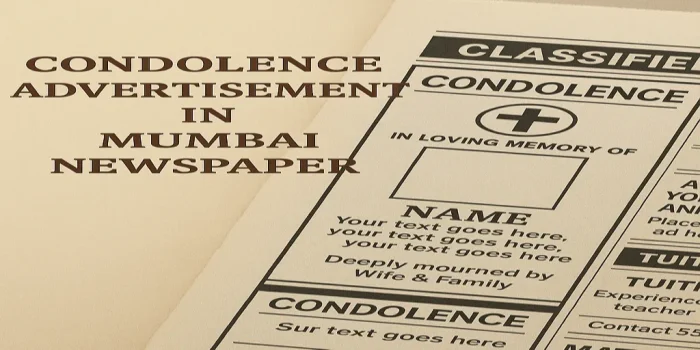
All of the announcements mentioned above are made by the family of the person who has died. A condolence notice is unique, as it is published by another person, group, company or organisation to express sympathy and respect.
Who Places Condolence Ads:
Condolence notices are typically issued by people, companies, and organisations to convey their grief, respect, and support following someone's death, and are usually published in Indian newspapers:
- Employers and corporate houses (for a senior employee, partner, or founder).
- Business associations and trade bodies.
- Alumni networks (IIT, IIM, university associations).
- Social clubs, NGOs, or charitable organizations the deceased was part of.
- Close friends or family friends who want to make a public expression of grief.
- Political parties or government bodies for public figures.
What a Condolence Ad Should Say:
Condolence letters are usually formal, respectful and sincere. People don't issue it like a press release or a regular message. Rather they utilize it to make a public concern to grief, regard, and remembrance for a person that shared a significant connection with the person, company, or organization that writes the notice.
Common phrase structures:
- "[Organization name] mourns the passing of our esteemed colleague and friend, [Name]..."
- "It is with deep sorrow that we learn of the sad demise of [Name]. His/her contribution to [field] was immeasurable."
- "Our deepest condolences to the [Family Name] family on this irreplaceable loss."
- "A great loss to the industry / legal fraternity / medical community / nation."
What condolence ads should not include: A condolence notice is a formal and serious message of condolence. It is published by people as a sign of true grief, respect and remembrance for the deceased. This is a personal message, because it is a personal, professional or emotional connection to the person who died, not just a typical public message.
Category 4: Remembrance Ads — Honoring an Anniversary
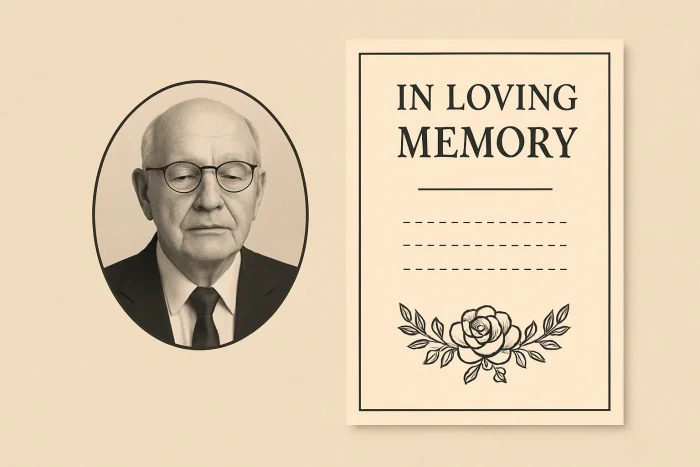
Grief doesn't go away after a few days or months. Families will never miss their loved ones' birthdays, death anniversaries and even everyday moments. Remembrance ads enable families to share that love and memory in a public and meaningful way.
Death Anniversary Notices:
These notices are typically published on the 1st, 3rd, 5th or 10th death anniversary or the year of the family's choosing to be publicly remembered. The first death anniversary notice is the most common and emotional as it's the first anniversary of the loss, and it is a reminder that love, memories and grief are alive and well.
Common language for death anniversary ads:
- "A year has passed, but your absence is felt every day."
- "Not a day goes by without your memory."
- "We remember you today and always."
Birth Anniversary Notices (Shradhanjali):
As a tribute to the life, the memories and the values of the deceased, their families post Shradhanjali notices on the day of the death. Shradhanjali is a Sanskrit term derived from Shradha (reverence) and Anjali (offering), and therefore is a respectful tribute to a person who is no longer with us. These ads typically feature an emotional and encouraging message and often feature a picture, memory or phrase like "You taught us that kindness costs nothing" or "Your laughter still echoes in everything we do."
Key Language for Remembrance Ads:
- Death anniversary: "Fondly remembered," "Gone but never forgotten," "Forever in our hearts"
- Birth anniversary: "Shradhanjali," "Remembering your light," "Celebrating your life"
- General In Memoriam: "You live on in all who knew you," "Your memory is our greatest inheritance"
Practical Tips for Booking the Right Ad
Classified Text vs. Display Ad:
A classified text ad displays as basic text and is printed alongside other classified ads in the newspaper, and is a quick and economical advertisement to use for a death notice, ceremony invitation or brief remembrance notice. A classified display ad costs per square centimetre with plenty of room for a photo and custom design and a detailed obituary or tribute to your family — it's perfect for full obituaries, important ceremony invites and emotional anniversary memorials. In most cases, the family is opting for a text classified ad for emergency death notices because classified ads are processed quickly and published in the newspapers, while a display ad with a photo is likely to be the best choice to provide a meaningful and respectful obituary for the departed.
Include a Contact Number for the Ceremony Venue:
This is one of the most helpful bits of information to post in a ceremony notice, but many families don't. There is often an absence of signage at large venues in Indian cities and guests coming from the outside may need assistance in locating the venue. For those who navigate by phone, it will be very easy to add a contact number to the notice. If the family does not want to provide a personal number they may make use of the venue's landline number or a contact number for a trusted family member who can direct visitors safely.
Regional vs. National Newspaper:
A Times of India notice reaches those who read the English newspapers in the city. However, a regional language daily may be more effective at reaching the right readers — especially if the family or community primarily use another language:
- North India: Dainik Jagran, Dainik Bhaskar, Navbharat Times (Hindi).
- Gujarat and Marwari communities: Divya Bhaskar, Gujarat Samachar (Gujarati).
- Maharashtra: Lokmat, Maharashtra Times (Marathi).
- Kerala: Malayala Manorama, Mathrubhumi (Malayalam).
- Tamil Nadu: Dinamalar, Dinamani (Tamil).
- Andhra Pradesh and Telangana: Eenadu, Sakshi (Telugu).
Many families have both types of notices published. They set up an English notice to interface with their professional network and a regional language notice to interface with their community and extended family.
Everything You Need to Know About Publishing an Obituary in Times of India
FAQ: Types of Death Announcements in Indian Newspapers
- Q1. What is the difference between an obituary and a remembrance ad?
An obituary is published right after the death and is typically released within a day or two to let people know a loved one has died and to provide information about the funeral or ceremony. A remembrance ad (also known as an In Memoriam or Shradhanjali ad) is another ad that follows the birthdays or death anniversaries to bear the name of the person remembered long after they have departed. The obituary tells; the remembrance ad tells and tells some more. - Q2. When should a Chautha notice be published?
The Chautha notice should be sent 1–2 days prior to the event so that friends and relatives are able to make their travel arrangements, particularly if commuting from another city. The notice is generally submitted on the second or third day after the passing as families keep the Chautha for the fourth day. Early morning booking helps in getting the notice published the same day or the next day. - Q3. What does "Uthala" mean in a death announcement?
Uthala is a ceremony that is primarily celebrated by the North Indian, Hindu, and Punjabi communities. It's the final step in grieving. The word is derived from "uthna" (to rise) and it reveals a gradual emergence from a profound grief of the family. By publishing this in the newspaper, friends, family, co-workers, and the community are reminded that the final prayer meeting will be held and that they are invited to attend and say their condolences. - Q4. Is it necessary to include a photograph in a newspaper death notice?
There are no legal requirements for the photograph in the Indian death notice, but families strongly prefer it. A lot of people have the same names and are living in the same city, so the picture is useful to help readers identify the correct person. It is also useful for distant acquaintances to recognise the face. Portrait images for display ads print sharp at 300 DPI, and poor quality photos or group photos do not work well when printed in newspapers. - Q5. What is Besna in the context of Gujarati or Marwari communities?
Besna is a formal sitting where the bereaved family will be visited by people who come to condole. It's derived from the term "baisna" meaning to sit, in reference to the family sitting together in one place. The newspaper notice clearly states the date, time and location. Besna gatherings can last for hours and can even spread over one or more days. - Q6. Can I publish a condolence message for a business associate?
Yes, it's totally normal in India. In cases of a business partner or colleague, professional group or trade body, or mentor's death, condolence ads are published in major newspapers by the companies which they worked with, belonged to, and/or mentored. These advertisements are respectful, heartfelt and supportive of the family who have lost a loved one. They also identify the work the individual contributed to the organisation and the professional community. - Q7. What are Bhog and Antim Ardas?
Both are a part of Sikh tradition. After a death, the Akhand Path — continuous reading of the Guru Granth Sahib — is completed with the Bhog, and this usually takes 48–72 hours. Antim Ardas is the last congregational prayer for the peace of the deceased soul. The notice in the newspaper calls the Sangat to the Gurudwara for these ceremonies, and typically concludes with the Sikh phrase "Waheguru Ji Ka Khalsa, Waheguru Ji Ki Fateh." - Q8. What is the difference between a Classified Display ad and a Display ad for obituaries?
Small to medium-sized, boxed advertisements in the classifieds section with a picture, typically priced per Sq. Cm., are called Classified Display ads. They show more visibility than a text ad, while still being in the classifieds column. A Full Display ad is typically a larger ad that appears in the same spot as a page of editorial content, and can be a quarter, half or full page. For high profile families and organisations, Full Display ads are preferred for big tributes, while most families use Classified Display ads for their regular memorial notices. - Q9. Can I include all family members' names in the ad?
Yes, and this has been a custom in Indian death announcements. The family members who are still alive are listed under 'Kripakanshi' (those who mourn) and most often include the spouse, children and spouse, grandchildren, siblings and often the name of the business. All the names are sometimes included in large families to connect with the family's complete structure and also for members of the community to see how they are related to the bereaved family. - Q10. How do I book a death announcement in a regional Indian newspaper?
Almost all the leading newspapers in India like the Times of India, Dainik Bhaskar, Malayala Manorama and Eenadu make it possible to book classified ads online. Text, photo and documents can be uploaded and the publication date selected. Where there is no system providing bookings online, an agency makes the bookings via various newspapers. Before you begin the process, make sure you have a scanned Death Certificate or Cremation Receipt on hand.

 admin19 February, 2025
 admin20 February, 2025
- admin21 February, 2025
- admin22 February, 2025